What size dozer do I need to clear trees on a lot in Norris?
Trunk diameter, root depth, slope and soil all decide the machine, and the wrong one costs you time, turf and topsoil.
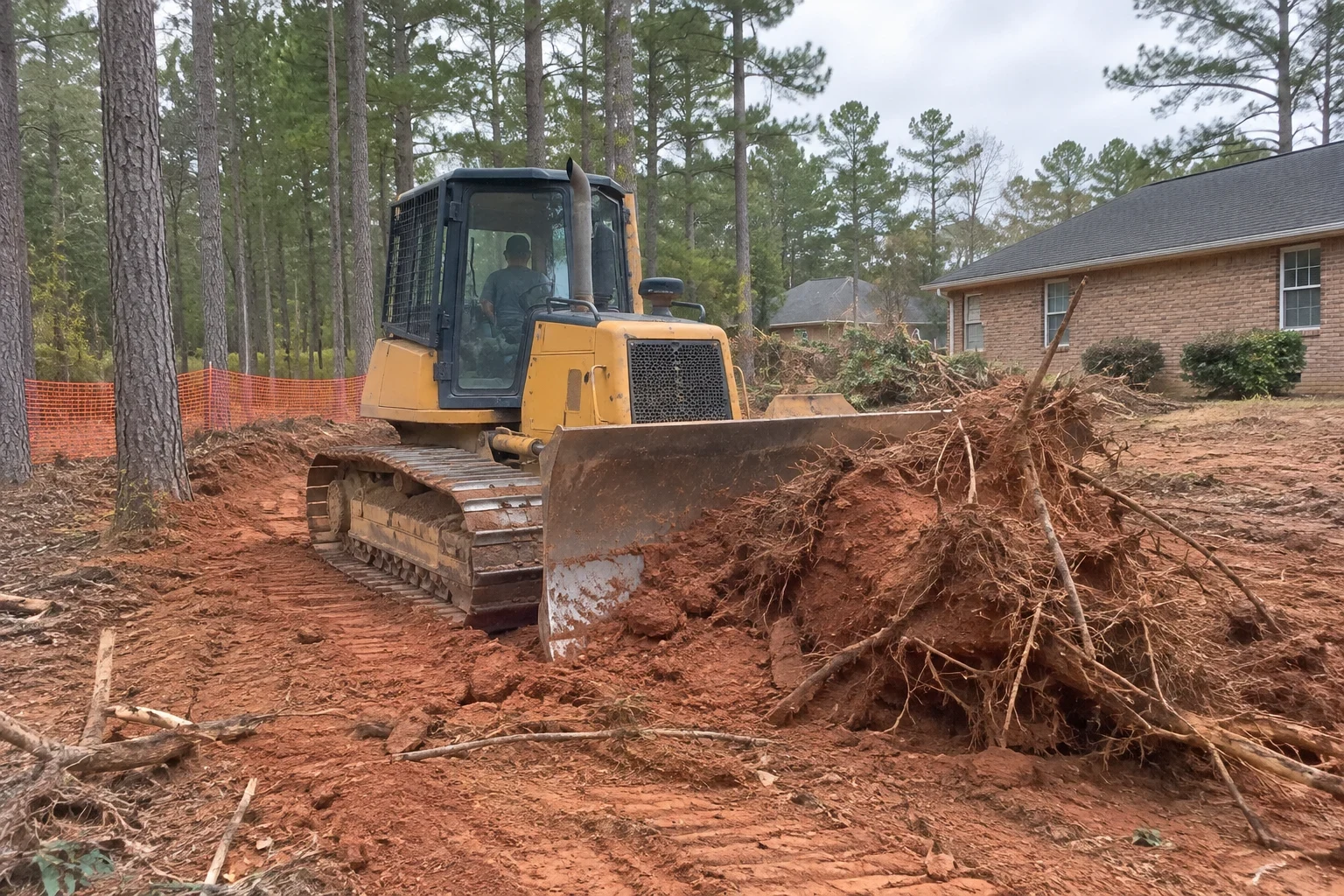
What size dozer do I need to clear trees?
For brush and trees under about 6 inches across, a small dozer in the 70 to 100 horsepower range is usually enough. For mature pines and hardwoods in the 12 to 20 inch range, you want a mid-size dozer or an excavator working alongside it. Larger trees are cut first, then the stumps are pulled.
How tree size matches dozer class
A dozer clears trees by pushing on the trunk high enough to use it as a lever. The roots let go and the root ball comes up with the tree. That works only if the machine has enough weight and traction to hold its ground while the trunk resists. Too light a machine spins its tracks, digs a trench and leaves a snapped trunk with the stump still in the ground.
These are the general size classes and what each handles well:
- Compact track loaders and small dozers: brush, privet, briars and saplings under about 4 inches. Good for underbrush on a lot that is mostly open.
- Small dozers, roughly 70 to 100 horsepower: young pine stands and hardwoods up to about 6 to 8 inches across. Light enough for tight lots and a narrow driveway entrance.
- Mid-size dozers, roughly 100 to 200 horsepower: mixed woods with trunks up to 12 to 16 inches. This is the most common class for clearing a homesite.
- Large dozers above that: heavy timber and big stumps over larger acreage. Rarely the right choice for a single house lot because they are hard to bring in and they compact a lot of ground.
Why an excavator often does the heavy lifting
On most wooded lots we pair a dozer with a tracked excavator. The excavator reaches up the trunk, pushes it over in a controlled direction and then works the root ball out with its bucket and thumb. The dozer follows to push debris into piles and shape the ground.
This split matters for the trees you want to keep. An excavator can drop a tree away from a keeper oak or a neighbor's fence line. A dozer pushing blind into a stand cannot place a falling 60-foot pine with that kind of control.
Big trees with real timber value, or anything leaning toward a structure, get cut with a saw first. Then the stump is pulled or ground. Felling a large tree with a machine alone can split the trunk and throw it the wrong way.
What the lot itself changes
Tree size is only half of the decision. Upstate red clay holds water through the winter, and a heavy dozer on saturated clay sinks, ruts and smears the surface into something close to pottery. On a wet site we either wait for the ground to firm up or choose a lighter machine with wider tracks to spread the load.
Slope changes things too. Many lots around Norris fall toward a creek or drainage, and a dozer working across a steep grade loses traction and stability. On those lots we often clear from the top down and keep the heaviest work on the flatter part of the site.
- Access: a gate, culvert or narrow drive can rule out a large machine before work starts.
- Soil moisture: clay that is too wet compacts and loses its structure, which shows up later as standing water.
- Slope: steeper ground favors excavators and tracked equipment set up to work along the contour.
- Keeper trees: roots spread well past the drip line, so we fence off that zone to keep machines from crushing them.
Stumps, topsoil and getting ready to build
Clearing for a house is different from clearing for pasture. Every stump and major root under the future footprint has to come out, because buried wood rots and leaves voids under a slab or footing. A machine big enough to pull the root ball cleanly is worth more than one that pushes trunks fast and leaves roots behind.
We try to strip and stockpile the topsoil separately from the root mat so it can go back on the yard later. Once the debris is handled, by hauling, grinding or burning where local rules allow, the site is ready for grading and then foundation work. Choosing the right machine at the start keeps the subgrade firm for both of those steps.
More questions about clearing trees
- Can I rent a small dozer and clear the lot myself?
- For brush and small saplings, some owners do. Mature trees, stumps under a planned house and slopes are where rented machines get stuck or leave roots behind, and that costs more to fix during grading.
- Do I need a permit to clear trees on my land?
- It depends on how much ground you disturb and where the lot drains. Larger clearings can bring stormwater and erosion control requirements, and burning has its own rules, so we check those before the first tree comes down.
- What happens to the trees after they are cleared?
- Logs can be hauled off, ground into mulch on site or burned where that is allowed. We talk through those options with you before work starts so nothing on your lot is a surprise.
- How do you protect trees I want to keep?
- We mark keepers before machines arrive and fence the area under their canopy. Keeping equipment off those roots prevents the slow decline that shows up a year or two after construction.
Talk through your lot before any trees come down
Tell us about your land, the trees on it and what you plan to build. A project consultation covers the right equipment, which trees to keep and how clearing leads into grading and your foundation.